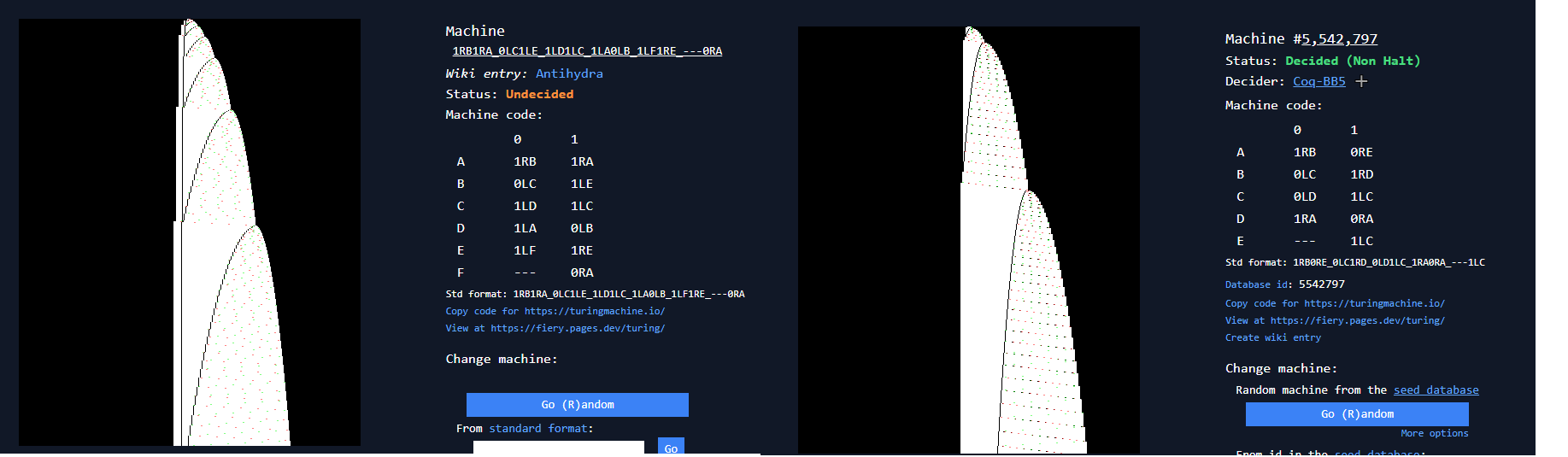
honestly, looking at these two side-by-side, it’s basically a wrap for the antihydra “conjecture.” if the 5-state copycat (#5,542,797) is already a proven non-halter, there’s like a 99.9% chance antihydra is just a slightly “extra” version of the same thing.
they both start with that same 4-one bootloader, and at 10m steps, the “training” looks identical—they’re just dense shredders carrying numbers across the tape to do math. the only real difference is that 45-degree slant, but that’s just a visual drift; it doesn’t change the core instructions.
why it’s mathematically impossible for it to halt:
the self-healing logic:in the 5-state machine, it only hits state E (the halt check) when it’s mid-math and already has a 1 to latch onto. it never even sees a 0 in that state.
the antihydra shield: antihydra is even “creepier” because it has state F. even if it hits a 0, it writes an “insurance 1” and moves left. if it finds a 1 there (which it always does because it’s a dense shredder), the F1 → 0RA rule kicks it right back to state A.
the bottom-left trap:** both machines have their --- halt in the same spot (E0 or F0). but since they follow preset instructions and always write 1s when they see 0s in the main states, they literally can’t fall off the cliff. they build the floor as they walk on it.
cracking this is huge because it puts us one step closer to BB(6). once we prove antihydra is just a “slanted” version of the 5-state bouncer we already solved, the trophy is basically waiting for whoever writes the formal certificate. it’s not a mystery anymore; it’s just a deterministic engine that’s too productive to ever die. Or i could just be dumb.
Hi!
There’s a crucial difference between the two machines that makes the analysis of antihydra much harder: the leftmost block of 1s on the tape. In the space-time diagram of antihydra, you can see the right side of tape takes a similar “bell” pattern as the 5-state machine, but there’s also a smaller block of 1s on the left side separated from the bells. The halting condition of antihydra is related to the size of this block of 1s - in particular, reaching the halting transition requires that this block of ones gets reduced to nothing.
In the terms you used in the post, antihydra writes these “insurance 1s”, but it also will occasionally use them. The halting vs. non-halting difficulty in antihydra comes from understanding the size of this left block. The 5-state machine you noted thus really doesn’t provide much insight into the problem, since it doesn’t really have an equivalent of this afaik.
I’d recommend looking at the bbchallenge wiki page for antihydra (Antihydra - BusyBeaverWiki), specifically the “Analysis” section and corresponding proofs. Hopefully that’ll give you an idea of why your 5-state machine differs from antihydra.
More generally, Turing machines with similar-looking space-time diagrams may be vastly different in the difficulty of their analysis. This is a mistake I would make when I started getting involved here, and so there’s no shame in that at all.
Also, if you plan on analyzing more Turing machines (something we’d highly appreciate!), I’d recommend trying to be a bit more precise with language. Your post contains a lot of unclear terms like “insurance 1”, “bottom-left trap”, and “dense shredder” - it may not be clear to readers what these mean. As such, it’s difficult for others to engage with your findings, since we aren’t able to reproduce the logic you used. For instance, you claim the E0 → F transition will always land on a 1 “because it’s a dense shredder”. Without knowing exactly what “dense shredder” means, we can’t reproduce the logic that got you to this conclusion. I suspect that’s why this post hasn’t gotten a response yet - the language is too ambiguous to properly verify/refute your claims.
To be clear, this response isn’t meant to discourage you from trying to help with the analysis of Turing machines. In fact, it’s the opposite of that - we want you to keep helping out! But in a collaborative project like bbchallenge, making precise and careful arguments is important to ensure both that the results are accurate and easy for the other members to understand.
Thanks!
1 Like